
 | | | |
| | Getting rid of an unwanted heritage | |
| | | |
“The aims of the National Environmental Remediation Programme include
a) identification of the magnitude of risk, extent of pollution and deterioration of the groundwater and the geological medium,
b) lowering the risk of pollution in the endangered areas, and
c) reduction of the level, or elimination of pollution in the polluted area.”
(Government Decree No. 33/2000. (III.17.) On activities that affect the quality of groundwater, sub-section (5) of section 4.)
The implementation of the Programme has started and is now running without loud publicity. The general public is not much aware of the tasks to be carried out under the Programme, their nature and the ways they are being implemented. Issues like the remediation of the hazardous wastes in Garé (South Hungary), or the deteriorating situation in and around the Metalloglobus Ltd’s site in Nagytétény (Budapest), occasionally receive some media coverage, therefore these names may sound familiar to a certain extent. Back in the early 90s more could have been heard about the serious dangers that the sites abandoned by the Soviet troops presented to the environment. It is obvious that sooner or later these and other similar environmental damages will need to be remediated.
It is unlikely however, that everyone could fully be aware of the nature and extent of those damages, that required launching a government programme; of what sort of difficulties may these damages cause in the everyday life of the country and the individuals; of whether all these problems could be solved, and if yes, then how; and of where are all these issues placed on the priority list of the tasks to complete for the Hungarian policy and economy.
| | | |
| | I. Questions and answers | |
| | | |
| | | |
| | What have we inherited? | |
| | | |
Since the early times of economic development, and especially from the beginning of industrialization, the industrialized regions (i.e. those considered developed) all over the world were characterized by smoking factory chimneys, coal-heaps, spoil-banks, slag-hills, massive amounts of steel drums, sedimentation lagoons and waste dumps. The evolvement of environmental protection and its integration into the legislation and enforcement was necessary to avoid these concomitant phenomena as inevitable necessities of further development. Meanwhile, in developed countries many old factory buildings were demolished or modernized, spoil-banks and waste dumps were recultivated, and chimneys disappeared or were put out of use. Today’s typical industrial or agricultural plant is served by dust-free road, tidiness and order prevail inside and outside, the site is surrounded by green spaces, and even within the fences the area is landscaped. In this part of the world, however, only a few industrial/agricultural/commercial sites have clean surroundings yet. Nevertheless, environmental protection is gradually thriving in our country as well, and by now, due to the continuously developing environmental legislation and administrative organisation, it is no longer allowed to start activities entailing higher environmental pollution than legally determined. In parallel, more and more measures encourage and promote the reduction and finally the elimination of the environmentally harmful effects of economic activities started earlier. The apparent development in the lawful behaviour of both individuals and society is assisting the efficiency of the administrative and institutional measures.
However, the consequences of past environmentally harmful economic activities have stayed with us. In many cases materials were left behind, that are most often hidden, as they were left below the surface, or even if visible, their present potential for causing environmental damages can not be established with simple methods. And thousands of tons of industrial wastes (mainly hazardous wastes), leaked fuels, other oil derivatives and the multitude of harmful substances have entered the subsurface zone. Such contaminated areas, the pollution sources, and their harmful impacts may be very varied, e.g.:
- a very large number of sites or installations where crude oil or oil derivatives are being stored: airports, oil refineries, railway stations, filling stations (during refilling the spilled fuel can reach the ground surface, storage tanks can get perforated by corrosion, and stored materials leak to the groundwater),
- chemical plants: storage tanks on the site area, underground pipeworks (these can also deteriorate, and leak hazardous substances into the groundwater),
- slag-hills, spoil-banks, sludge lagoons in the surroundings of factories, power plants and mines (the precipitation is leaching them and the dissolved hazardous substances are infiltrating below the ground surface and/or into the groundwater),
- military sites: garages, workshops, storage tanks of chemical substances (due to overspill, leakage or corrosion; hazardous substances could infiltrate below the ground surface and into groundwater from the widest range of abandoned or buried materials and equipments),
- railway stations: workshops and liquid fuel storage tanks (with similar polluting effects as mentioned above), past slag-dumps,
- disposal sites of liquid and solid wastes, in operation or often abandoned and forgotten
etc.
Though in many cases sites like mentioned above have in many cases been demolished or modernized, the substances hidden below the surface remained there. Other installations (e.g. military sites) have simply been abandoned altogether, with their contaminated areas.
The processes taking place on such sites are less apparent than the smoke of a factory chimney or the sight of fish-kills in oil spilled waters, the consequences however will still sooner or later present themselves and they can be serious.
It happens sometimes that the wind picks the contaminated soil or the polluting substances up, with the precipitation the substances fall down to the terrain surface, and they enter the food chain through the vegetation, damaging the ecosystems, and the human organism at the end of the food chain.
It is also occurring that in a region some kind of respiratory disease becomes more frequent, or harmful substances are appearing in the bodies of people living there. In such cases only lengthy investigations can identify the cause, the abandoned and perhaps hidden pollution source. These long-term environmental damages therefore represent an important constituent of the environmental pollution, adversely influencing the general medical state– and after all the life expectancy – of the population.
The most frequent scenario, however, is that the rainwater, leaching through the contaminated areas, dissolves the hazardous substances and transports them into the groundwater. The same happens to chemicals frequently overdosed in agriculture. In settlements unserved by sewerage, wastewaters are simply released directly into the groundwater. As the groundwater is generally in motion, and is able to transport dissolved contaminants to long distances, they can reach the valuable uncontaminated waters situated at greater depths 1 . Since more than 95% of the drinking water supply in Hungary is based on various groundwater resources, this pathway may represent a special danger to the population. Consequently, it may become necessary to abandon contaminated abstractions, and to develop new ones. The costs associated might be many times more than the new development of the same abstractions again, as the area of the abandoned site shall be remediated. 2
This means, that the abandoned contaminated areas, pollution sources – even if hidden – are still alive, their lives are only out of our sight.
Pollution sources and polluted sites are also hindering the restructuring of the economy, especially in the traditionally industrial regions, as they are taking up the areas required by the restructuring. Moreover, they are hampering the consistent regional development too. (For example housing estates must not be developed over a covered waste disposal site unless the harmful substances are removed. The case can even be worse, if buildings have already been erected, unaware of the hidden pollution source.) Polluted areas are causing concern to foreign investors as well, as they can not always know what kind of hidden pollution sources may accompany the acquired real estate.
And the number of this kind of more or less hidden, neglected and ownerless pollution sources, contaminated sites may reach tens of thousands in the country. This means that in average at least one, but probably more could be found in every 3x3 km area in Hungary…
| | | |
| | What can be done? | |
| | | |
It is beyond dispute that this situation must not be left as it is. Some uncertainty is caused, however, by the lack of precise information on the number of operating pollution sources and contaminated areas in the country, on their location, on the kind of contaminating substances they are releasing into the environment, and on the potential receptors of the contamination, and on the level of risk they could represent. In such a situation the population is exposed to a risk of unexpected and unavoidable, even disaster-like events.
The situation is not much better even in the developed countries, although there the problem has been realized as early as in the 70s, while in Hungary – in full scale – only in the early 90s. It is imaginable and understandable that in every country numerous professional and public debates preceded the formation of the more or less uniformly accepted system of remediation 3 . The originators of the Hungarian National Environmental Remediation Programme utilized the ideas developed in this way when elaborating the domestic methodology. The main features of this methodology are the followings.
It is certain that at firstthe seriousness of the problem shall be appreciated. As mentioned above, although a smaller part of the pollution sources is fairly well known by the relevant institutions, the greater part of them is unknown. In Hungary for example, it is only a fraction of the contaminated areas (the full number of which is estimated to several tens of thousands) on which the environmental authorities, local municipalities, and possibly other organizations have certain (by no means detailed) knowledge. The research and processing of these data held at various places(assessment), and subsequently the registration of the pollution sources shall already provide some outline overview on those dangers at least, on which some information exists somewhere(Annex 1).These operations shall be carried out coherently (by filling in data sheets of standardized content). Systematic data collected this way can already be registered. The assessment of the potential and actual pollution sources causing long-term environmental damages requires a large amount of detailed work. To complete the existing information, site surveys shall be carried out, and new methods (e.g. aerial photography and satellite image processing) shall be applied, which can help to identify differences in the colour and extent of the vegetation from the surroundings, indicating something extraordinary on or below the ground surface, in some cases providing more information than the archives 4 .
Based on a risk assessment of the information from the completed datasheets, the individual sites receive priority numbers. Thepriority listcompiled from these numbers sorts the sites according to their importance/urgency: which remediation (fact-finding) has to start sooner, and which can wait for a later start. As further sites come to light, this list has to be continuously amended, as it may happen, that the remediation of a later identified site proves more urgent than the ones explored earlier… In this context furtherrisk assessmentis carried out 5 , focusing on the level of harmfulness of the substance found on the site, on the way and direction of its spreading, on the nature of the substance it is converting to, on the size of the population it can reach, and on the extent of the damage it can cause in human health, in the biosphere and in the environment.
Sensitivityof the investigated areas plays an important role in setting priorities. Sensitivity is “the set of natural conditions characterizing the resistance to risk substances of the groundwater and the geological medium”(Gov. Decree No. 33/2000. (III.17.) Korm. On activities that affect the quality of groundwater.).This means that those areas are of high sensitivity, where the geological formations containing or covering the groundwater are, by their nature, less able to protect the groundwater against pollution arriving from the surface (or from lateral directions) and vice versa. Consequently, sensitive areas must be higher up on the priority list. Annex 2/1 of the quoted Government Decree definesprominently sensitive areas, sensitive areasandmoderately sensitive areas. This means that the prominently sensitive areas must be given higher priority within the sensitive areas.
Even more attention must be paid to theparticularly sensitive areas of groundwater quality protection. These are those prominently sensitive- and sensitive areas, where the groundwater is close to the terrain surface (in 10 m order of magnitude), where the groundwater has no protective geological formation above against polluting substances, and most importantly, where they are located on designated (or under designation) protective areas of abstractions serving the present or future drinking water supply, the utilization of mineral or medicinal waters. These areas will evidently receive high priority. Otherwise the designation of protective areas and the respective prohibitions and limitations are regulated by theGovernment Decree No 123/1997. (VII.18.) Korm. On the protection of the actual and perspective sources and the engineering facilities of drinking water supply. This is interface between OKKP and the Programme on the Protection of Drinking Water Abstraction Areas. The two programmes must be interfaced and their harmony ensured, as the health of the present and future generations is in the focus in both programmes.
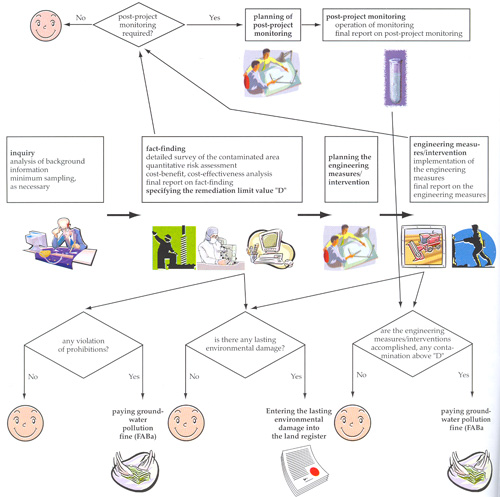
From this point onwards the individual cases shall be treatedone by one:the substances present shall be identified, their spread shall be delineated, and the area shall be determined where the environment has already been contaminated. When sufficient information became available on the site, on its surroundings, and on the hydrogeological conditions (e.g. depth of the groundwater level, nature of polluting substances already dissolved, directions of transport), the likely future spreading of the polluting substances can be forecasted by computer modelling 6 . For on-site information, exploratory boreholes are drilled on the surveyed site and on its surroundings, samples are collected, and their composition and concentration are analysed in laboratories. The exploratory boreholes are constructed in a way enabling them to serve as part of the long-term monitoring system in the future, as these sites will need to be observed for a long time, regardless whether or not intervention was made. Those undertaking the investigations are literally groping in the dark, as in most of the cases they can not see just what they are investigating, and it is only from the data of the exploratory boreholes that they can extrapolate to the processes taking place in a large subsurface area, and to what may be expected for the future.
All these cost a lot of money. It is therefore important e.g. to drill only as many exploratory boreholes and to undertake as many analyses, as necessary to obtain the required reliable knowledge. This much, however, has to be spent on the investigations, as over-economy leads to unsatisfactory knowledge, and unsatisfactory knowledge might cause false judgement on the danger. If so, the measures considered necessary would not correspond to the real danger, and the costs necessary to amend the erroneous measures at a later stage would exceed the savings achieved on the investigations. Thereforefact-findingis usually undertaken in several stages. First the local situation is roughly explored, the results are evaluated, and the necessary decisions (on the methods and level of details of the subsequent, more detailed stage, which will also be followed by further evaluation) are made after only then, having finished the first exploration stage.
Having the technical plans developed and the permitting process completed, the necessary engineering measures(intervention)can start. Several kinds of approved engineering measures are available. Out of these the selection has to fall to the one that is the most adequate (under the given natural and environmental conditions) for the nature of the identified polluting substances and for the scale of the danger to be eliminated. Also, the costs necessary to reach the same or nearly the same objectives, are important. This is determined by thecost-effectiveness analysis.
A few examples for possible engineering measures:
etc.
By now, of course, much more intervention methods are available; the number of the better-known procedures in Hungary is about 80. 7
The last stage of the remediation is thepost-monitoring. This means the operation of the monitoring system developed (and perhaps improved) during the fact-finding process, and the regular evaluation of the results in the remediated area and in its surroundings. This stage assists in ascertaining the success of the remediation. The monitoring system shall therefore be kept in operation for several years after the completion of the engineering measures, keeping under supervision the remediated area and its surroundings 8 .
It is apparent from what was said so far, that the costs are high even in simpler cases. Only a few examples:
This emphasises the importance of the above-mentioned – and perhaps complicated looking – procedure of assessment, preparation & maintenance of priority lists, fact-finding, risk assessment and cost-effectiveness analysis, because these steps ensure, that the limited funding available could always be used for the actually most important tasks.
| | | |
| | Who is to pay? | |
| | | |
Both common sense and civil rights considerations suggest that damages shall be paid for by the party which caused them. Cost-bearing is closely related with the responsibility in every sector of life, this is why the “polluter pay” principle is prevailing in environmental regulations all over the world. In this principle It is always implied, that the party causing the damage shall pay the costs of the remediation, too. Since the entry into force of the Act on Protection of the Environment in 1995 it is clearly established, that the owner and the user of the real estate (where the illicit activity was performed) are bearing joint and several liability. The owner’s possibilities for exemption are limited, as the owner can only be exempt by naming the actual user of the real estate, and proves without doubt the user’s responsibility.
The group of illicit activities is clearly determined by the Act, as those activities or non-feasances that
a) endanger the environment
b) pollute the environment
c) damage the environment
d) are performed violating the environmental regulations.
On the basis of the above regulations it is clear that both the legal liability and the obligation to restore the original state shall be born by party undertaking the illicit activity, i.e. the causer of the damage. The identification of the causers of the damage is one of the most important objectives of the authority procedure. If despite all due care and caution the causers of the damage cannot be identified, then, on the basis of the rules of joint and several liability, the owner of the real estate shall take the responsibility. In this case the onus of proof reverts and the owner must prove that not he/she is not responsible for the illicit activity, and must name the actual user of the real estate.
TheGovernment Decree No. 33/2000 (III. 17).Korm.On activities that affect the quality of groundwater. provides special regulations, e.g. if the party performing the activity is unknown, or liquidated without legal successor and if the activity endangering, polluting or damaging the groundwater or the geological medium
a) has been performed or is being performed after the entry into force of the Act on Environmental Protection, then the owner or user of the site of the illicit activity is obligated to implement the remediation on the basis of Section 102 of this Act;
b) or, if it was performed before the entry into force of the Act, then on behalf of the Hungarian State, the organization assigned by the government minister put in charge of such remediation by the distribution of tasks and responsibilities within the administration, or if there is no other responsible, then the organization assigned by the government minister in charge of the environmental protection is obligated to implement the remediation.
It is important to call the attention to the decisive role of the provision in the first sentence in sub-section (3) of Section 4 of the Government Decree 33/2000 (III. 17) Korm., relating to legal succession of the activity. According to clause a) of sub-section (2), Section 67 of the Act on Environmental Protection, the termination of the operation shall also be considered as an activity having significant impact on the environment. Therefore in case of selling a particular site, if the termination of the operation causing contamination is still in course (as the environment is still being endangered), then the new owner of the site – as legal successor to the activity – shall be obligated to carry out the remediation.
When the developed countries first faced these problems, it soon became evident, that the tasks required management at a state level (usually by development of national remediation programmes) due to their size, the public interest they attracted, and their arborescent nature. In certain countries as e.g. in the USA, Germany, The Netherlands and Denmark such government programmes have started and are in operation since the mid 80s already, while in the rest of the developed countries they were organized and introduced later; in certain cases they are under preparation now. The size of the task did not immediately become clear; there were cases when the initial estimation of implementation cost had later to be amended to ten times the original estimate. It has soon become clear that in certain cases the state had to participate in the funding as well, a good example of this is the central financial fund called “Superfund” in the USA, legally regulated since the early 80s. The same conclusions had to be drawn in course of elaborating the Hungarian OKKP as well 9 .
| | | |
| | When is clean the clean? | |
| | | |
Or, at what point can we say that a remediation process can be terminated, as the remediated site is “clean” by now? This question appears to be simple. However, both soil and water are containing by nature a multitude of the various substances. The composition of these substances and their concentrations are varying in different cases. It may even happen, that dangerous or hazardous substances can be found in natural waters, in a concentration harmful to the human health (e.g. the occurrence of natural, mineral-originated arsenic in the groundwaters in Southern Hungary). As the saying goes among hydrochemists, only those substances are not present in water, which can not be detected. Indeed, with the development of the analytical technology new substances can be detected in water. At the same time, there are substances the lack of which might make the water unfit for purpose (e.g. really clean, distilled water is unfit for human consumption). In light of this it is understandable, that there are many debates on the questions: when are the environmental elements (water, air, soil) “not clean” by nature, when are they not clean due to pollution, when can a remediation process be terminated (i.e. when can we say that the soil or water at a particular place is “already clean” or “satisfactorily clean”).
One extreme of the approaches is the mechanical application of the so-called Dutch List; the other is represented by the method applied mainly in Germany.
With the time passing, some convergence can be observed between the two approaches.
The method adopted by the developers of the Hungarian OKKP is based on the pre-pollution, quasi-natural state (characterized by thepollution limit value “B”) of the water and the soil(Annex 2). This limit value is “the risk (hazardous) substance concentration set forth in an act of legislation, or in the absence of one, in an official ruling (authority decision), with due regard in the case of groundwater to the requirements of drinking quality and the aquatic ecosystem, in the case of the geological medium of the full range of soil functions (multifunctionality) and the sensitivity of groundwater to pollution”(Gov. Decree No. 33/2000. (III.17.) Korm. On activities that affect the quality of groundwater).If the hazardous substances in the water or soil do not exceed the limit value“B”,then, although the soil or water are no longer in their natural state, but they can not yet be considered contaminated. The local regulation determines individually the concentrations to which hazardous substances shall be removed from the particular area. This is theremediation limit value “D”determined via careful risk assessment, cost-benefit analysis, taking the land-use into account . This value can not be less then the above mentioned“B”limit value.This means therefore, that generally the remediation is not required to reach a cleaner state than the pre-contamination state of the given environmental component.
The limit values are established by theJoint Decree 10/2000 (VI. 2) KöM-EüM-FVM-KHVM of the ministers of environmental protection, public health, agriculture and regional development, and of transport, communication and water management on the limit values necessary to protect the quality of groundwater and the geological medium.Annexes to this Decree contain that e.g. how many mg/kg of copper, zinc, lead, etc. is the background-concentration(A), the pollution limit value(B),the intervention limit value(Ci)of the soils or waters in Hungary.
| | | |
| | II. The National Environmental Remediation Programme | |
| | | |
| | | |
| | Antecedents | |
| | | |
Before the elaboration of OKKP there were already some signs showing that the hidden or uncontrolled abandoned pollution sources might cause damages. One of these was the sudden and unexpected contamination of the drinking water from theVác-South abstraction area in the 80s. Lengthy investigations were required to demonstrate, that the pollution was caused by the hazardous substances originating from the nearby (improper) waste disposal site of Chinoin Works, infiltrating under the terrain surface in the background area of the bank-filtered abstraction site, and seeping into the wells. The well field had to be disconnected from the communal drinking water network. In one of the well fields ofSzekszárdtown a few wells also had to be disconnected, because of a contamination of unidentified origin of their water. Special attention was drawn to this type of dangers by the recognition of what a large number of contaminated areas were left behind by the leaving Soviet troops in the surroundings of practically each site they used.
The Short- and Long Term Governmental Action Plan of 1991 can be considered as the starting point of OKKP, in which the tasks of survey, exploration and elimination of the accumulated environmental contaminations appeared already. One of the objectives of the Plan was the elimination of environmental pollution of the evacuated Soviet barracks and drill grounds. Mainly due to the lack of financial resources, until 1995 the implementation of this task has started only, under the professional management of the Institute of Environmental Management, the background institution of the Ministry of Environment. This was also the period of the preparation/elaboration of OKKP.
| | | |
| | Stages of OKKP | |
| | | |
The Government, in its Decision No. 2205/1996 (VII.24) adopted the National Environmental Remediation Programme and its short-term stage as Appendix “F” to the National Environmental Programme, while the Government Decision No. 2304/1997 rules on the tasks of the medium-term stage. Stages of OKKP are:
Summarized:
The expectation of the society, that the implementation of such a manifold and expensive mass of tasks shall be organized upon clear, understandable and acceptable leading principles, is therefore fully understandable.
| | | |
| | Leading principles | |
| | | |
The following leading principles are governing the implementation of OKKP:
| | | |
| | Organizing the OKKP | |
| | | |
Tasks included in OKKP can be classified into three main groups:
• General tasks
These include:
• Countrywide tasks
These include:
In order to harmonize the countrywide tasks, anInter-Ministerial Expert Working Group –consisting of members delegated by the relevant Ministries – is in operation.
• Individual projects, investments
Everything discussed so far is serving the individual projects, i.e. the reduction of the contamination risk in the endangered areas, the reduction or elimination of contamination in the polluted areas, as required by the Government Decree quoted at the beginning of the present overview. All the tasks discussed above are aiming at enabling the identification of endangered and contaminated areas, at establishing the level of danger and damage, at supporting the decisions on the measures, and subsequently – depending on the position of the site on the priority list – at enabling the successful completion of the decided measures.
Thus the main stages of the individual remediation projects are:
It is worth to consider at this point, that these three stages together may last many years and they may cost several millions of HUF. The sites affected by the individual projects may either be in state ownership, or owned by companies or private persons. The implementation of every project funded from state funds shall be tendered according to the Act XL of 1995 on Public Procurements.
| | | |
| | What has been achieved so far? | |
| | | |
The full duration of OKKP is expected to be forty years, if at least a yearly HUF 25 billion can be made available for its implementation. During this time 30 to 40 thousand potential pollution sources, probably causing contamination, shall be dealt with.
In the past years:
· with theUSA(In September 1997 the Ministry for Environment and the Trade and Development Agency of the USA signed a cooperation agreement. Under this agreement TDA funded the feasibility studies of three remediation projects in Hungary for $ 500 thousand.)
One of the lessons drawn from the listed cooperation activities and other international connections should be mentioned: Hungary is in the forefront among the countries of Central-Eastern Europe in the field of measures taken for environmental remediation.
| | | |
| | Key tasks of the future | |
| | | |
It might appear sufficient to say here, that everything, started in OKKP, should be conscientiously continued. However, there are some groups of tasks in OKKP, the completion of which requires special emphasis, as their implementation promotes the progress of other tasks. These are e.g.:
|


| | | |
| | Final remarks | |
| | | |
It is certain that those, who got acquainted with the problems of environmental remediation through reading this booklet, must have met a number of new concepts for them. The issue itself is such, that can not be easily overviewed. There may be readers hardly believing the seriousness of the situation, the volume of funds required for the solution, though the text and figures above comply with reality. Also it has surely become evident that the enormous volume of polluting materials accumulated almost since the beginning of the industrial revolution can only be eliminated with careful, diverse, well-based, conscientious work, taking – unfortunately – a long time. Perhaps it has also became clear, that such a “clean-up” of the country is not an issue having an end in itself, but its every element serves directly the interests of the Hungarian population. Hopefully the references made in the text are assisting the reader in further research. More information can be obtained at the Environmental Inspectorates and at the customer service office of the ministry responsible for environmental protection, on 3,5" diskettes or can be downloaded from the Internet (www.kvvm.hu).
Footnotes
- 1 More on the groundwaters in Hungary in: Guide, Groundwaters in Hungary (Compiled by the Hydrological Institute of VITUKI Plc, commissioned by the Ministry of Environment)
- 2 More in: Hidden value to be guarded. A legal instrument [Government Decree No. 33/2000 (III.17.) Korm.] and what is behind (2001)
- 3 More in: International Experience of the Clean up of Contaminated Areas (1997). Remediation booklets No. 2.
- 4 More in: Survey of Land Uses and Pollution Sources Damaging Groundwaters and the Geological Formation by Remote Sensing (2001). Remediation guides No. 3.
- 5 More in: Methodological Principles and Peculiarities of Preliminary risk Assessments in the International Practice (2001) Remediation booklets No. 6.
- 6 More in: Use of Models on Contamination-Spreading (1998). Remediation handbooks No. 1, further in: Detailed Risk-Survey of Contaminated Areas (2001). Remediation handbooks No. 3.
- 7 More in: Technologies of Remediati on (2001). Remediation handbooks No. 4.
- 8 More in: Monitoring of Groundwater in Areas of Lasting Damage (1998). Remediation guides No2, further in: Baseline Study to the Content-requirements of Monitoring (Final report, VITUKI Plc. 2001).
- 9 More in: International Experience of the Clean up of Contaminated Areas (1997). Remediation booklets No. 2.
- 10 More in: On the Study of Contaminated Soils (1998). Remediation handbooks, No. 2.
- 11 More in: Limit Values, System of Values in the National Environmental Remediation Programme (1998). Remediation booklets No. 4.
- 12 More in: Technologies of Remediation (2001). Remediation handbooks No. 4
- * Felszín Alatti Víz és Földtani Közeg Nyilvántartási Rendszer: FAVI
- ** Nemzeti Kármentesítési Ptioritási Lista: NKPL
- *** Felszín alatti Víz és Talajvédelmi Információs Rendszer:TIM
- 13 More in: Commentary on the Sensitivity Maps (2001). Remediation booklets No. 7.
- 14 More in: Recording of Lasting Environmental Damages into the Land Register (1997). Remediation Guides No. 1.
- 15 More in: Commentary to the Sensitivity Maps (2001). Remediation booklets No. 7.
| | | |
| | Annex 1 | |
| | | |
| | | |
| | Annex 2 | |
| | | |
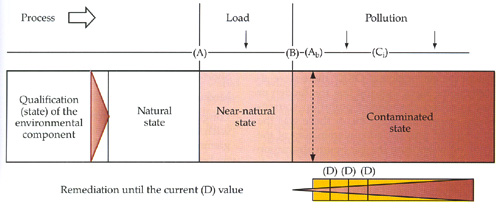
Explanation:
“ Loading (of the environment) :emitting a substance or energy into the environment.” (Sub-section f) of section 4, Act on Environmental Protection).)Substancemay be anything, occurring in nature, or produced by society/economy.
“ Pollution :any discharge deteriorating the state of the groundwater, or the geological medium, which poses a risk to human health, to water uses, to the permitted uses of the environment, and is harmful to the flora and fauna” (sub-section 5 of section 3, Gov. Decree No. 33/2000. (III.17.)) on activities that affect the quality of groundwater=D.).
“ Emission: access of the risk (hazardous) substance to groundwater or the geological medium as a result of human activity” (13/3, D). This means that in this case a substance is entering nature in a harmful quantity.
“Contamination (level of pollution) :risk (hazardous) substance concentration in groundwater or in the geological medium, which can be described in terms of pollution limit values” (6/3, D)
“ Background concentration (A) :Representative value, typical concentration of a particular substance reflecting natural, or close to natural conditions in the groundwater or in the soil” (11/3, D). That is the concentration of a certain substance (mg/kg) of which it can be said that the groundwater or soil is “clean”under average conditions prevailing in Hungary. Coming from the foregoing this is atheoretical value.
“Demonstrated background concentration (Ab): Concentration representative of a particular area as the resultant of natural conditions and a load via an element of the environment other than groundwater and the geological medium. This is to be applied in lieu of the background concentration(A)” (12/3, D). This is already a measured value (if there were measurements in course of the fact finding) varying site by site, unlike the representative value(A).
“Pollution limit value (B): Risk (hazardous) substance concentration set forth in an act of legislation, or in the absence of one, in an official ruling, with due regard in the case of groundwater to the requirements of drinking quality and the aquatic ecosystem, in the case of the geological medium of the full range of soil functions and the sensitivity of groundwater to pollution.” (7/3, D). This means that when the concentration of substances specified as hazardous ones is higher in the geological medium (soil) or in groundwater than the value(B),then the geological medium or groundwater can not be qualified as “clean”, but ascontaminated(even if the level of contamination is very low, this must be declared). The soil or water containing hazardous substances at a concentration between values(A)and(B)is yet in thenear-natural state,being yet below the pollution limit value.Multifunctionalityof the soil means that it has more than one function. Above the pollution limit value(B)the authority may take measures. In case of arable land – if the state of affairs is in line with c)/5, D– then the authorityshalltake measures.
“(Ci) = C1, C2, C3 intervention pollution limit value: risk (hazardous) substance concentration set forth in an act of legislation, or in the absence of one, in an official ruling. In cases, where this limit(s) is(are) exceeded … the competent environmental authority (inspectorate) is obligedto intervene.” (9/3, D). In this case the geological medium (soil) or groundwater is already heavily contaminated/damaged and this state is presumably the consequence of human pollution. Occurrence of such concentrations does not necessarily mean that engineering intervention will be required, it does mean, however, that fact finding will be required to establish whether or not engineering intervention will be required. The value of(Ci)varies depending on the on the sensitivity of the particular area. Value of(C1)is the lowest and it shall be applied in the prominently sensitive areas (e.g. in the close vicinity of water intakes, at national parks areas). In such areas therefore interventions are required at lower concentrations of hazardous substances, whilst in less sensitive areas the occurrence of higher values will require intervention.
“Remediation limit value of pollution (D): concentration prescribed in an official ruling under a remediation procedure, on the basis of a complex assessment involving the distribution of the risk substance among the elements of the environment, a measurement, or model investigation on its behaviour and spreading, a quantitative risk analysis and the land uses …to be reached as the result of remediation.” This is the value for which the contaminated soil or groundwater shall be “cleaned up” on the given site. This value is varying from site to site. A lower concentration – possibly the limit value(B)– shall be targeted where a low concentration may already more seriously endanger the human health than at other places (again, in the vicinity of water intakes, around play-grounds, recreational areas, etc.). Therefore all the time-, labour- and cost requirements of the engineering intervention depend on the soundness basis for the(D)value!
Finally it should be noted that all concentrations and limit values relate to hazardous substances . As defined by D: “ Risk (hazardous) substance: any substance produced by some human activity, which, because of its toxic, carcinogenic, teratogenic, mutagenic, bio-accumulative, or other adverse effect, poses a risk to the environment, to human health and to the uses of the environment when present in the geological medium and/or in the groundwater. These substances include in particular those listed in Annex 1 of the present Decree.”
| | | |
| | Annex 3 | |
| | | |

Explanation:
The remediation tasks are implemented on the given sites in the framework of remediation investment projects .
The remediation projects are pertaining to the sub-programs of OKKP. The minister competent according to the government’s work-sharing pattern is directing the implementation of the particular sub-programs, organised by the institution assigned by the minister. The Minister of Environment and Water is also responsible for certain sub-programmes.
Some individual projects are not transferable to others , but are still under state responsibilities , and because of their particularities these do not belong to any sub-programs – not even to the own sub-programs of the minister in charge of environmental protection. The Minister for Environment and Water is responsible for their implementation.
The so-called in lieu projects are launched when the obligated party does not complete them by the deadline as specified in the authority decision, and the remediation can not be delayed for environmental reasons. As set forth in the subsection (1) section 82 of the Act No. IV. of 1957 on State Administration Process in such cases the relevant authority implements the remediation on the account and risk of the party responsible for the contamination, with subsequent recovery of the costs. Providing the necessary funds is the responsibility of the minister in charge of environmental protection.
In the group of general tasks mainly the operational activities of OKKP are included, e.g. the development of the legal, technical and economic regulations, R+D activities, development of the organisational structure, other works serving the unification, and the information dissemination (e.g. the elaboration and publication of the present booklet).
The countrywide tasks include all the activities covering the whole territory of the country, e.g. the countrywide assessment of pollution sources and contaminated areas, development and operation of the information system, coordination of the sub-programs, etc. For the latter two tasks the Minister of Environment and Water is responsible.
The responsible legal successors with funding deficiency may receive state support in a tendering system e.g. non-refundable financial support from the Central Environmental Fund.
