
 |
|
|
|
|
|
INTRODUCTION | |
|
|
|
|
Economic growth, especially vigorous industrial development, tools place in Hungary without the constraints of strong environmental protection regulations up to the end of the seventies and the beginning of the eighties. Although the legal regulations concerning environmental protection later caught up with contemporary requirements, compliance with the regulations fell far short of the theoretical strictness of the limits and other regulations for a decade or so. In the midst of the economic difficulties of the time, only insubstantial amounts could be spent on environmental protection. This situation has led to a gradual accumulation of non-degradable and slowly degrading pollutants in groundwater and the soil.
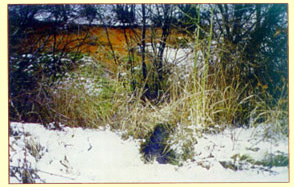
GYÖNGYÖSOROSZI
Bence Valley Reservoir - levee leak February 20, 1996
(Photo by Éva Deseő)
There are approximately ten thousand polluted areas in Hungary where cleanup would have been an imperative for years, even decades. The environmental protection authorities, local governments, and possibly other organizations have information (which is far from complete) concerning only a fraction of these. The pollution of the soil and groundwater is obviously less perceptible than smoke-emitting factory chimneys, petrochemical city smog, or dead fish in oil-stained rivers; but their harmful effects can be felt. At best, we "merely" have to pay for the cost of replacing polluted water utility wells (it must be noted that more than 90% of public water consumption in Hungary comes from groundwater); at worst, human health can be threatened by the consumption of polluted water or garden-grown vegetables or even by recreation in polluted areas. Nevertheless, pollutants do get washed into surface waters, and decomposing hazardous wastes do threaten the environment through the air. This long-term environmental damage constitutes one of the factors of environmental pollution that has an unfavorable effect on public health and, ultimately, life expectancy. With most long-term damage, the person (legal entity) that is responsible for the pollution cannot be compelled to clean up: In these cases, the coordinated use of government funds is necessary in order to clean up.
|
|
|
|
|
|
INTERNATIONAL EXPERIENCE | |
|
|
|
|
It was only 10-15 years ago that the developed Western countries realized that polluted areas had to be gradually cleaned up. Germany (FRG), the Netherlands, Denmark, and the United States were among the first to react to the problem, while a high-level program is currently being implemented or, at least, planned in almost all of the EU member countries.
The task is enormous, even for the most affluent countries. This was not immediately evident. It was not unusual that the initial estimates for the cost of implementation later had to be increased tenfold. All of the countries are planning programs to be in effect for more-than a decade. Even at the stage of planning, the development of soil and water protection strategies as well as the legal, technical, and economic regulations is necessary. The program organizers have faced numerous issues that have given rise to serious social debate. These issues include determining responsibility and, in connection with it, financing the work (which tasks are to be paid for by the persons that caused the damage and which are to be financed publicly? ); the criteria for establishing intervention priorities; the rational objectives of interventions (the question is well-known: how clean is clean? ); and the impact on property values. It was usually recognized early in the course of planning the programs that the first step has to be a thorough study that will enable comparisons and uniform priority calculations. In the absence of such a study, the amounts to be spent on eliminating damage will not be efficiently used, and money might be wasted in some places, while other places might experience insufficient funding. Initially, various theoretical criteria were applied in the stipulation of clean up objectives and intervention limits. In the United States, an individual risk analysis is prepared for each examined area, and the specific tasks depend on the results of these. The Dutch practice faithfully followed the principle laid down in the European Soil Charter with regard to the soil's multifunctionality requirement. A state of cleanliness that is suitable for ecological and human activities must be achieved in all cases. In Germany and elsewhere, the list of limits was categorized according to area use requirements, adding that these limits are only starting points for individual evaluations.
In practice, most countries today tend toward using limits in the first phase of uncovering pollution and individual risk analysis in detailed investigations. Although there are many methods of financing, government budgets dominate most of the time. The differences lie in the kinds of income schemes that provide coverage. These include product charges, waste taxes, and environmental protection contributions and fines, though on occasion there are no special sources and the public bears the full burden through the budget. The principle of "polluters pay," which is widely accepted in environmental protection, is least applicable here, since it is often impossible to prove the responsibility of the polluters.
|
|
|
|
|
|
DOMESTIC ANTECEDENTS | |
|
|
|
|
The government's 1991 short- and medium-term action plan, which identified the tasks of surveying, uncovering, and terminating accumulated environmental pollution, can be considered as the starting point for the Remediation Program. The same plan deals with solutions to the environmental problems presented by abandoned Soviet barracks and training grounds. Owing to the lack of funds, only the latter task could be started before 1995 under the technical direction of the Ministry for Environment and Regional Policy and the Environmental Management Institute. The remediation of the most polluted of the former Soviet properties, will have been completed in 1-2 years.
The experiences obtained in the course of privatization (many foreign investors were concerned about the risk of "inherited" environmental damage connected to properties), the revival of the real estate market, the experiences acquired as a result of the upsurge in bankruptcies and liquidation, and, hopefully, the developing public participation in environmental protection all helped provide justification for the Ministry for Environment and Regional Policy's original initiative.

Nyírlugos
A 20-meter well on the site of a former mill and lumber mill, the presumed location of the pollution source
(Photo by Emesee Ilyés)
Therefore, the government launched the National Environmental Remediation Program in 1996 in order to assess polluted areas, uncover damage that falls within the scope of the government's responsibility, and eliminates the damage.
In September of 1997, Parliament has approved the National Environmental Program which contains the Remediation Program.
|
|
|
|
|
|
GOVERNMENT RESPONSIBILITY | |
|
|
|
|
The new environmental protection law stipulates that, if no other person can be made responsible, it is the task of the government to eliminate the consequences of significant environmental damage.
Under certain conditions, the law stipulates the joint and several responsibility of the polluter and the owner of the area in which the activity causing the pollution is or was pursued. This provision will, in the long run, increase the chance of having the responsible persons, not the government, pay for eliminating environmental damage.
If, therefore, the polluter
- is unknown (or if the presumed polluter cannot be proved to be responsible),
- has been terminated without a legal successor, or
- is currently under liquidation and the liquidated assets have been proved to be insufficient for cleaning up the damage;
the pollution must be considered a government responsibility and the damage on the given area must be eliminated within the framework of the Remediation Program. Naturally, it is also the responsibility of the government to clean up long-term environmental damage caused by government budget agencies.
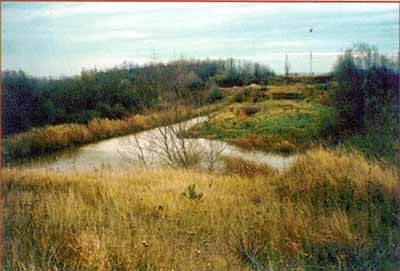
Pereszteg
A camel skin dump before cleanup - November 20, 1996
(Photo by Gabrielle Berta)
|
|
|
|
|
|
THE PURPOSE OF THE PROGRAM | |
|
|
|
|
The purpose of the Remediation Program is terminating the harmful and hazardous effect of long-term environmental pollution that falls within the scope of the government's responsibility.
In order to achieve this, the first step that needs to be taken is the comprehensive survey of long-term environmental damage (sources of pollution and polluted areas):
|
|
|
|
|
|
THE COURSE OF THE PROGRAM | |
|
|
|
|
The remediation concept extends over the entire process.
As the first step of the Remediation Program, the environmental protection authorities started to survey the entire coúntry in 1995 for pollution whose cleanup is particularly important. As a result, approximately 200 areas were registered. It is characteristic of the registered pollution that it endangers 86% of the soil and groundwater and a lesser degree of the air and surface waters.
|
|
|
|
|
|
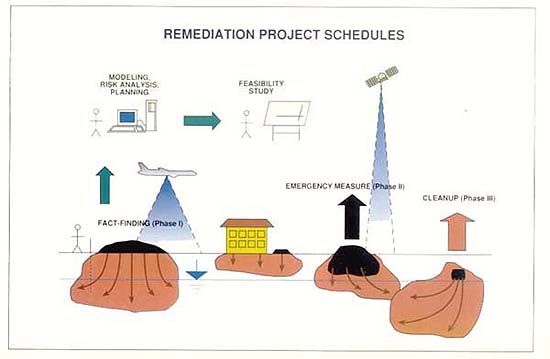
The Remediation Program Process | |
|
|
|
|

The assessment of pollution sources and polluted areas requires extensive and very detailed work, which would make it possible to enter the results in computerized data bases. Version I of the Remediation Priority List can be compiled on the basis of the registered data with the help of a preliminary evaluation.
If it becomes apparent from the available data (without any further investigation) that rapid intervention is needed, there must be a emergency measure, which usually entails the localization of pollution or the elimination of the source of pollution.
Fact-finding incorporates searching for the source of pollution, determining the damage to the polluted environmental component (soil, surface and subsurface waters, sediment, etc. ), modeling the extent of the pollution, and preparing a feasibility study for the cleanup. The observation facilities that provide for continued monitoring are usually implemented by the time the fact-finding has ended. Fact-finding can be divided into two phases: a diagnostic phase, and a detailed probe phase. The risk evaluation for the given area is prepared on the basis of the results of the investigation, and the area is put on Version II of the Remediation Priority List in order to determine its priority.
In the course of remediation the polluted environmental elements, the pollution is terminated or, if complete cleanup is not possible or if the target condition determined by the risk calculations does not warrant it, reduced. The soil or water must be cleaned of pollutants, and the specified limit values must be met. If the intervention does not result in the complete elimination of pollution, the urea will be put on Version III of the Remediation Priority List following another risk analysis and evaluation.
The follow up ensures the continuous monitoring of the results of interventions. Follow up, which relies on the data provided by the observation facilities, can last for several years.
In the course of the program, if remediation would take several years, the environmental protection authorities will take measures to register the long-term environmental damage in the property register and, once the post-inspection is completed, have the entry removed.
Békéscsaba Békés Megyei Patyolat Vállalat [Békés County Laundry Co.] The area along the northeast fence after the emergency measure (Photo by Péter Schultz) |
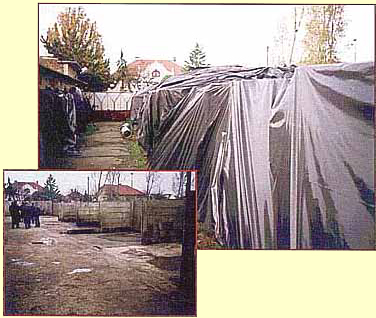 |
Barrels piled up in several rows and covered with plastic film along the site's northeast fence |
|
|
|
|
|
|
PROGRAM PRIORITIES | |
|
|
|
|
In the course of the remediation, the optimal solution must be realized in order to protect human health, as well as the flora and fauna. The requirements of environmental hygiene, therefore, are of primary importance in risk calculations, while, at the same time, cost efficiency requirements are also built into the evaluations.
Current and planned area use characteristics influence the degree to which soil is cleaned. Groundwater water resources that are located in the catchment area of mineral, medicinal, and drinking water bases enjoy priority, regardless of the type of water (shallow groundwater, lcarstic water, banlz-filtered water, or deep groundwater).
Intervention has a higher priority for water resources that are located in vulnerable geological environments.
The basic requirement of the remediation process is to prevent the spread of the pollution from one environmental element to another.
|
|
|
|
|
|
PROGRAM TASKS | |
|
|
|
|
The program incorporates three distinct groups of activities.
The general tasks include operating, managing, and coordinating the program. The recurrent tasks include compiling the annual priority lists and announcing tenders for companies that undertake to search out and clean up pollution (usually by means of the public procurement procedure in accordance with the size of the project). Strategic tasks include research and technical development that meets the program's needs and the creation of a basis for developing legal, technical, and economic regulations. For public acceptance of the program, the development of a communication strategy and public relations, the organization of educational programs, and the editing and publishing of technical publications are indispensable. The development of a twotier (central and regional) information technology system is considered a general task. 16% of the program funds were used in 1996 for the performance of general tasks. The assessment of sources of pollution and polluted areas is the most important of the national tasks.
This includes the registration of longterm pollution in the property register (in accordance with uniform nationwide procedures), the central operation of the monitoring system, and the development of groundwater monitoring and the Soil Protection Monitoring (TIM) system.
Another national task entails the development of so-called subprograms for remediation projects for which government organizations bear statutory (or contractual) obligations.
6% of the program funds were used in 1996 for carrying out national tasks.
Individual tasks include the investigation of damage and remediation projects for which the government is responsible as well as local monitoring, both according to schedules that comply with priorities.
|
|
|
|
|
|
CONNECTION TO OTHER PROGRAMS | |
|
|
|
|
In 1996, 78% of the program funds were used for performing individual tasks.
The Wellfield Protection Program adopted by the Government in 1995 is aimed at securing both operating and prospective wellfields that are located in vulnerable environments. In the course of this program's diagnostic investigations, water catchment areas are identified with the use of models (the size of the area from which any possible pollution can reach the wells in a specific period of time is determined). In the protected zones of wellfiels that have been specified in the above manner, potential pollution sources are assessed, and appropriate observation and monitoring zones are developed. The cost of developing and maintaining protected zones is paid for by the government in the case of prospective wellfield and, in other cases, by the license holder that uses the water. The alternatives to securing an area are worked out on the basis of an evaluation of the conditions, which follows the segregation of actual and potential pollution sources. Decisions concerning the measures that must be taken in order to secure an area (in addition to developing a monitoring system) are made in consideration of the cost/benefit analysis. of each of the alternatives. This can also include eliminating the existing pollution in the ground or groundwater as well as eradicating the cause of the pollution.
The need for coordination between the Remediation Program and the Wellfield Protection Program can be clearly recognized with regard to assessment and registration as well as the actual cleanup. The people who are in charge of implementing the two programs act as liaisons in the area of exchanging information and malting the actual decisigns to clean up pollution.
There are also close ties with the National Environmental Health Action Plan (NEKAP), whose purpose is to survey and rank the most important environmental hygiene problems and study possible solutions at the national, regional, and local levels. The National Environmental Health Action Plan has also established a common database for the i polluted areas, and it rates planned interventions.
The National Environmental Health Action Plan rates pollution by evaluating the environmental hygiene risks and considering local characteristics and possibilities. In some sample areas, highly detailed analysis (e.g. environmental epidemiological investigations) are made in order to calculate risks. The findings of the National Environmental Health Action Plan provide a reasonably good basis for making comprehensive priority calculations, especially from the perspective of the Remediation Program.
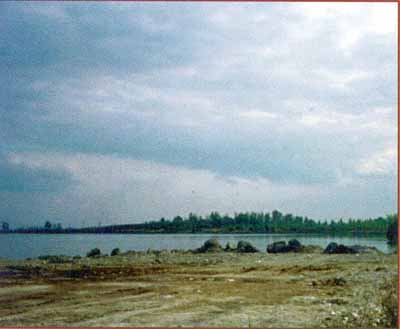
Sajólád
Water-Base
Quarry lake in Alsózsolca - potential source of pollution - October 20, 1996 (Photo by Éva Deseő)
|
|
|
|
|
|
PROGRAM PHASES | |
|
|
|
|
The first two years of operation ( 1996 and 1997) can be considered the program's short-term phase.
The development of the research, information technology, regulatory, and monitoring systems started in the period during which the program was established and its methodology created.
The government's responsibility and participation were clarified. The program's medium-term phase was compiled. The process of nationwide assessment began; and emergency measures, investigations, and cleanup projects were carried out with regard to individual tasks. The preparation of the related subprograms was in progress in 1997.
The program's medium-term phase ( 1998-2002 ) has five principal aspects.
ˇ The information technology background and research and technical development will continue to be emphasized in the course of carrying out the general tasks. These include, for example, compiling and publishing a list of the most suitable modern technologies for cleanup projects as well as developing methodologies for risk evaluation and cost/benefit calculations.
Since the calculations that determine remediation priorities must be made in the various phases of preparation (on the basis of information of varying profundity), the calculation methods must be applicable in several versions.
The compilation of the list of priorities for the current year, híased on topical information, is a general task. The investigations and cleanup projects that are to be carried out (or begun) in the given year can be determined on the basis of this list.
The above area after the waste had been removed (Photo by Péter Schultz) |
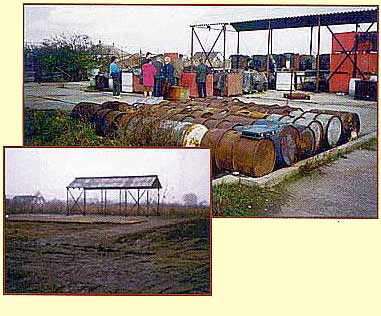 |
Kállósemjén |
One of the important tasks of the medimterm phase is the development of the Remediation Program's funding system. This must take into consideration the fact that the fund requirement for the tasks planned for the medium-term phase exceeds HUF 20 billion as well as the fact that the cleanup of the environmental damage that has been generated over several decades will also last several decades following 2002 with a cost that will probably run into the hundred billions.
Important national tasks include a comprehensive assessment of the actual and potential sources of pollution that cause long-term environmental damage, as well as registration of the findings by developing an information system for inventory of polluted sites so-called IMNFO, which is integrated in the Environmental Information System. The most comprehensive version of the Remediation Priorities List was prepared on the basis of this for 2002. Of course, this cannot be considered the final list, since the continuous maintenance of data will have to be ensured even in the future, and long-term environmental damage can arise even in the meantime, although hopefully to a lower number.
The national investigation entails a search for the sources of pollution that fall within the range of the government's responsibility, as well as those that do not. As part of this process, the existing data that can be used in the program are collected from various organizations (ministries, central or regional authorities, institutions, etc. ) and processed. Useful data are available from previous inspections of pollution that endangers protected natural areas, studies of pollution sources that affect the Balaton catchment area and the region between the Danube and the Tisza, and the Groundwater Management Atlas. The processing of aerial and satellite photos can also be very helpful. Pollution in the soil or ground water is sometimes more nóticeable on satellite photos of vegetation than in official files. Additional steps are the assessment procedure include on-site data collection, supplementing and updating information, and searching for unknown pollution.
The data obtained in the course of assessment are entered into the regional and national data bases in the KÁRINFO computer database management system, which will be available to the public in accordance with the legal regulations on public information.
The individual remediation tasks entail the investigation and cleanup of pollution for which the government is responsible in accórdance with the schedule determined by the priorities.
In the program's medium-term phase, which period is five years, diagnostic or partial investigations can be carried out in approximately 200 areas, if the program's finances are realized according to the plans. The need for rapid response will increase at first. Later, these interventions will be less characteristic. Accordingly, we can anticipate that emergency measure will be needed in approximately 50 cases.
Inota |
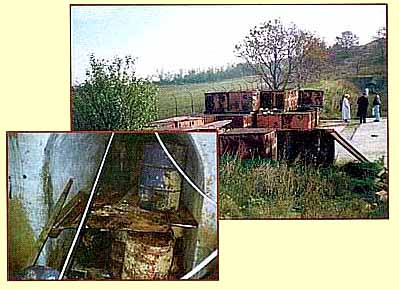 |
Containers of hazardous waste on the concrete-covered area in front of the explosives warehouse in Aszód |
As opposed to this, the annual number of cleanups after fact-finding will gradually increase. It is possible to estimate approximately 50-80 remediation projects for the period leading up to 2002. In terms of the need for follow up, this means that approximately 1000 observation wells (or other similar facilities) will be established before 2002 as part of the monitoring system.
Most of the pollution that falls within the scope of the government's responsibility must be cleaned up within the framework of the subprograms. The individual subprograms are aimed at cleaning up government properties that are under the management of state holding companies. Hungarian State Railways Company's (MÁV Rt.) environmental pollution, for example, will be cleaned up and the damage left by state mining projects will be eliminated within the framework of such subprograms. Subprograms will be created to eliminate the environmental damage on military properties and other pollution in areas and properties held by other ministries or properties in the possession of budget institutions.
According to the plans, State Privatization Agency (ÁPV Rt. ) will be in charge of two specialized subprograms. ÁPV Rt.'s cleanup tasks are aimed not only at the existing government properties, but at the properties that ÁPV Rt. has already sold and on which it has assumed environmental protection guarantees on the basis of contracts of sale or the law. The government cleanup of former Soviet properties is carried out within the framework of one of the subprograms. The other subprogram is the so-called corporate privatization subprogram, which also incorporates environmental protection guarantees that were made mostly on the basis of individual decisions in the course of sales negotiations. The implementation of the corporate privatization subprogram contributes to the privatization of some companies for which investor interest has so far been dampened by the companies' previous environmental problems and, consequently, the high risk resulting from the accumulated pollution.
The persons in charge of directing the subprograms use the same investigation, registration, and risk evaluation methodologies that determine the order of priorities in individual interventions. The damage investigated in the various subprograms, therefore, can be compared to the individual cleanup requirements. The schedule, which is based on a comprehensive calculation of priorities, can be influenced to a certain extent by the characteristics of the given subprogram (e.g. the manner in which military properties are used), its separate financial or budgetary position, or the deadlines for other tasks (in the case of ÁPV Rt.).
In the future, the government should not be held responsible for new long-term environmental damage, and the means of prevention must be created and developed in the program's medium-term phase. Prevention can be best served by the introduction of regulators, which have already been specified in the environmental protection law; these include environmental liability insurance and collateral requirements in proportion to anticipated environmental expenses. Although persons that pursue activities that pose a risk to the environment (e.g. persons that handle hazardous wastes) or obligees that have undertaken long-term official obligations are further burdened by this regulation, corporate tax regulations provide incentives for putting the planned expenses into provisions. It is hoped that this regulation will create a situation in which, even if a company becomes financially unstable, allocated funds will be (at least partially) available for cleanup or for satisfying compensation claims and the cleanup will not have to be carried out from government funds allocated for the program. Another possible way of prevention is to carry out the cleanup for insolvent companies with advance official funds.
Based on this, a special finance regulation scheme can be developed.
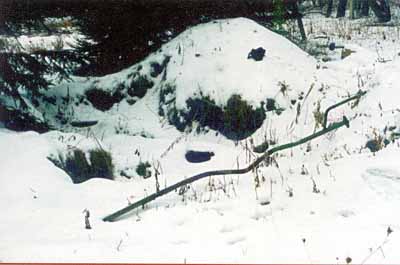
Ágfalva
People's Academy - oil container - January 21, 1997
(Photo by Viktoria Schreiner)
In simplified terms, the environmental protection obligation is replaced by the financial claim of the authority and therefore, as a result of flexible management and the possible participation of the Central Environmental Protection Fund, the company's liquidation due to the environmental debts of the previous years - or rather the previous decades - can be avoided, and the cleanup tasks that cannot be paid for with the liquidated assets will not burden the program. One possible example for the use of the scheme is the enforcement of Budapesti Vegyiművek Rt.'s responsibility for the hazardous wastes it has stored in Garé, South Hungary. (Obviously, forcing the company into liquidation would not be an appropriate solution in either economic or environmental protection terms.)
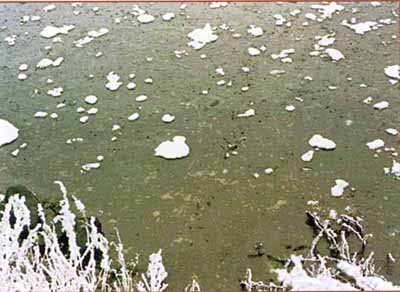
Debrecen
liquid waste deposit - oil baseu - February 20, 1997. (Photo by Viktoria Schreiner
|
|
|
|
|
|
PROGRAM FUNDING | |
|
|
|
|
In each of the program's first two years, the annual budget law allocated HUF 1 billion to the Central Environmental Protection Fund for implementation. ÁPV Rt. had to provide these monies from privatization revenue. Regular financing is necessary in the medium-term because of the termination of privatization revenues. The environmental protection law stipulates that the central budget and the government funds allocated for environmental protection must provide joint coverage for such expenditures.
According to preliminary concepts, the Central Environmental Protection Fund has the opportunity to collect its own funds if environmental load charges are introduced.
|
|
|
|
|
|
MANAGEMENT AND SPECTION | |
|
|
|
|
The Remediation Program is coordinated by the Ministry for Environment and Regional Policy with the participation of the ministries and professional and scientific organizations concerned. The program is operated by the Remediation Program Office, which was developed within the Environmental Management Institution, with the participation of the environmental protection authorities. The office's activities are supervised by the assistant undersecretary of state for the Ministry for Environment and Regional Policy. A team of professionals assigned by the various departments of the ministry assist the assistant undersecretary of state in his duties.
The Ministry of Environment and Regional Policy makes regular reports to the Czovernment concerning the program and the manner in which it is being implemented.
|
|
|
|
|
|
SPECIFIC ACHIEVEMENTS IN INDIVIDUAL REMEDIATION PROJECTS | |
|
|
|
|
In 1996, the Remediation Program Office announced open tenders for the diagnostic investigation of 15 areas and separate tenders for emergency measure in the case of eight of these areas. Nearly one hundred offers were received for the public procurement announcements.
The emergency measure were, with two exceptions, completed by the end of 1996, while the Remediation Program Office concluded contracts with the winners that bid for the diagnostic investigations at the beginning of 1997.
Most of the investigations were completed by June 1997.
Most of the program's first (rapid) responses were aimed at neutralizing the pollution that were mainly left by companies which had been terminated or liquidated.
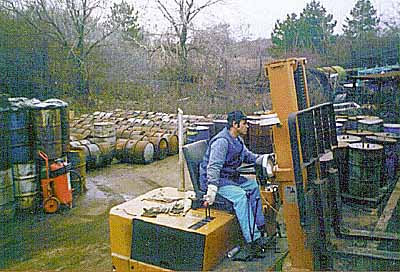
Törökbálint
Mechanikai Művek Rt. Cleanup at hazardous waste dump no. 1 with barrels of trichloroethylen in the background
(Photo by Pétev Schultz)
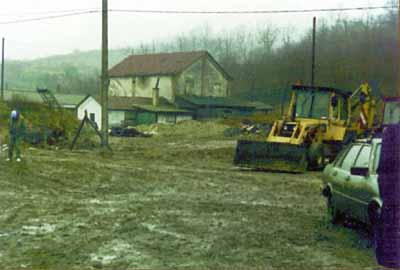
Szekszárd
Tischler, after the completion of the emergency measure, December 9, 1996
(Photo by György Maján)
In summary, the Ministry for Environment and Regional Policy's remediation project was launched in 17 areas in the second half of 1997. Investigations will begin in nine of these areas, and emergency measure is necessary in four areas. With four exceptions, the remediation projects begun in the previous years were continuing with detailed investigation of the work, supplementary emergency measure, and/or cleanup.
