| Thermal water resources in Hungary, their utilisation and protection |  |
NECESSITY AND POSSIBILITIES OF THERMAL WATER REINJECTION
To avoid the pollution by the disposal of used thermal waters in surface recipients and the pressure decrease as the consequence of thermal water production, the reinjection of thermal waters after utilisation appears as desirable solution.
In order to prevent the contamination of subsurface waters reinjection may be considered only when thermal water is utilised in closed energy production system, the possibility of pollution is excluded in a certified way and only into the subsurface space used for the thermal water production or for purpose identical with it.
In the case of balneological utilisation reinjection is allowed only when the reinjected water satisfies every environmental and public health prescription.
There are several examples of reinjection with wells in the world regularly in operation. Also the Hungarian oil industry applies water injection wells for the better production of hydrocarbons.
However examples connected to thermal water utilisation can be found mainly in the case of fissured reservoirs. International experiences are showing that the reinjection into fissured
rocks is a problemless issue, while on reinjection into porous clastic geothermal aquifers no information is available at the present time.
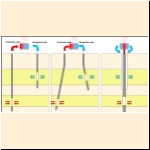
Nowadays in Hungary several systems are known where thermal water is being reinjected into the porous aquifers under lower pressure. Systems in regular operation have been constructed in Hódmezővásárhely, Szentes and Szeged. At the Szeged-Felsőváros Geothermal Heat Plant a doublet of diverted production and injection wells were drilled (Figure 7). At the Szentes and Hódmezővásárhely reinjection sites, production and injection is being realised with the use of the same well: the produced water is reinjected through the annular space (between the two sections of different diameters of the casing) into a layer in higher position (Figure 7). Data of the experimental and regular reinjections are summarized in Tables 2a and 2b.
| Table 2a | |
Summary of the experiences of thermal water reinjection in Hungary
| (porous formations) | |
|
Site (years) |
Rock |
Depth (m-m) |
Temp. (
o C) |
Note |
|
Szeged, the Algyő hydrocarbon field
(since 1969 in operation) |
Upper-Pannonian
sandstone |
950-1700 (prod.)
1900-2000 (inj.) |
- |
Injection of 20-200 m
3 /d into 500 wells. 500-140 bar, 10-50 mg/l susp. mat. |
|
Szeged, Szentmihálytelek
(1978-79, experiment) |
“ |
1450-1800 |
80-100 |
Inj. of 832-592 m
3 /d. 2,1-6 bar decreased to 1/5-1/10. |
|
Szeged, Móra F. Coop.
(since 1993-94) |
“ |
1659-1850 (prod.)
1655-1812 (inj.) |
80 |
Inj. of 300-1250 m
3 /d on - 2-8 oper. level. Static lev. of cooled w.: -52,8 m. |
|
Szeged, FLÓRATOM ltd.
(MOL Rt., 1996) |
“ |
1076-1284 (inj.)
1490-1653 (inj.) |
55
74 |
2 wells, 840 and 1610 m
3 /d 26-32
o C inj.
2,5-3,5 and 4,7-5,0 bar. |
|
Szeged, Felsőváros
(exper.: 1984-85, 1992,
since 1994 in operation) |
“ |
diverted doublet
1745-1898 (prod.)
1696-1917 (inj.) |
82
85 |
480 m
3 /d 67
o C 2,4 bar; 1080 m
3 /d
80
o C 10,5 bar; 720 m
3 /d 34
o C 1,6 bar;
1995/96: 600-700 m
3 /d, from 3-4 bar
increases to 15-19 bar. |
|
Hódmezővásárhely
remote heating plant
(since 1986 in operation) |
“ |
double oper. well
2060-2273 (prod.)
1386-1601 (inj.) |
86
60 |
960 m
3 /d 15-16 bar; in 10 years the required pressure was doubled. |
|
Hódmezővásárhely, Hódtó residence estate (GEOHÓD ltd.)
(since 1998) |
“ |
doublet
1833-1997 (prod.)
1473-1669 (inj.) |
74
61 |
In 1998 after a few days stabilised 1060 m
3 /d 3,0-3,5 bar. At the end of the 1999 season 700-840 m
3 /d, 4,0-4,5 bar. |
|
Szentes
remote heating plant
(since 1988 in operation) |
“ |
double oper. well
2094-2309 (prod.)
1065-1252 (inj.) |
95
56 |
Initially 720 m
3 /d, 4,5-5,1 bar;
528-600 m
3 /d, 4,8 bar. |
| Table 2b | |
Summary of the experiences of thermal water reinjection in Hungary
| (fissured formations) | |
|
Site (years) |
Rock |
Depth (m-m) |
Temp. (
o C) |
Note |
|
Nagylengyel
(since 1967 injection in oil ind.) |
Upper cretaceous limestone |
2000-2500 |
40-60 |
Since 1970 the water injected is more than the water produced with oil. |
|
Andráshida
(1990, MOL Rt. experiment) |
Upper cretaceous limestone |
2100 |
96-98 |
Planned: 2560 m
3 /d, 40
o C with 5 bar into the main karstic reservoir. |
|
Szigetvár
(1979, experiment) |
Cretaceous
limestone |
750-780 |
52-62 |
The wells of the doublet are too near to each other (290 m). |
|
Magyarhertelend, Cooperative
(in operation in the second half of 80s) |
Middle miocene sandstone |
551 |
- |
Received 360 m
3 /d water of cooled to 26-28
o C. |
|
Táska
(1980, experiment) |
Middle triassic limestone,
miocene limestone,
conglomerate |
620-650 |
78 |
982 m
3 /d injected with 2,2 bar; capacity decrease by 25 % because of sedimentation. |
|
Szentes
Remote heating plant
(since 1988 in operation) |
Miocene limestone |
1655-1715 |
- |
20-60 m
3 /d with 1,5 bar. |
Note: In the case of injection wells temperature of outflwoing water is given during production.
The Geothermal Public Utility System in Hódmezővásárhely is especially considerable where the favourable results experienced until now are the consequences of the precaution during planning and construction, the drilling technology fitting to the structure of the well, the minimization of pollution of the aquifer and the recipient layer, and the adequate filtering- and operating technology.
Although thermal water reinjection is still not a problemless issue in the case of porous clastic aquifers, results are considerable in a worldwide sense and the continuation of the process seems to be necessary.
|