| Monitoring of groundwaters in Hungary |  |
Quality monitoring
A comprehensive, countrywide ground water quality monitoring is just under development in Hungary; data that can be used for the characterisation of the chemical status of ground water bodies are obtained at present from different sub-monitoring systems and surveys. The greatest part of the investigations performed within the sub-monitorings is “routine” analysis covering the 15 (or less) main chemical components only. Not more than altogether 1200 groundwater analyses covers the micropollutants, but a lot of those extend over only a limited number of microcomponents. By the time about 600, more or less complete analyses are available performed in the last five years.
Ground water quality data acquired in the course the construction of wells
Since 1970 the routine analyses of 14 600 new drilled wells are available in the Water Resources Research Centre Plc. (VITUKI). The ground water quality data of the 60 000 wells drilled before 1970 are very insufficient.
Regular quality control of the municipal drinking water wells Ordinance No. 18/1992 (VII. 4.) KHVM of the Minister of Transport, Communication and Water Management on the requirements of the operation of public water facilities provides the regular quality control of the raw water of wells supplying municipal drinking water demands. The routine chemical data of more than 3800 wells collected this way are transferred to the DWAs annually and at the end they are stored in the database of VITUKI. Frequency of analyses is 1 to 12 a year. This huge amount of data will be the main basis of the surveillance and operational monitoring, since Government Decree No. 201/2001 (X. 25.) Korm. on the quality requirements of drinking water and the order of supervision thereof already provides the water supply companies the more detailed analyses of raw water including micropollutants.
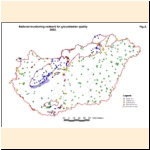
Basic Ground Water Quality Network The Basic Ground Water Quality Network consisting of 600 representative wells (Figure 5) was established in 1983. 97 of the wells have been sampled and analysed by the Regional Environmental Inspectorates (REI), the rest are production wells of the municipal drinking water supply companies whose responsibility is to forward the quality data to the DWAs. Frequency of analyses is 1 to 12 a year as far as the routine components are concerned. 70 wells in he most vulnerable areas have been analysed also for micropollutants, but only once up to now. Database is located in VITUKI, and VITUKI performs the yearly evaluations as well.
Monitoring of point sources of pollution The most important point sources of pollution have already been registered. Construction and operation of the local monitoring networks is the owners’ responsibility. Frequency and components of analyses depend on the type of the pollution source. Database and evaluation are the responsibility of the Institute of Environment Management (KGI).
Monitoring connected to the vulnerable perspective and actual sources of supply has already be mentioned when discussing the quantity monitoring, however its significance is even higher from the quality point of view.
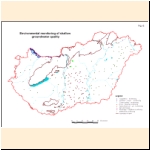
Environmental monitoring systems The present quality monitoring has some deficiencies mainly in terms of the most vulnerable subsurface sources – springs and shallow (< 20 m) groundwater - of supply Aiming at the elimination of these deficiencies the development of environmental monitoring systems has started (Figure 6)
Aiming at the elimination of the aforementioned deficiencies, the development of certain environmental monitoring systems have been initiated focusing on the most vulnerable ground water resources.
The Szigetköz area Here a monitoring-system has been developed to establish the influence of the Gabčikovo (Slovakia) Hydropower System to the ground water regime in the Szigetköz area and along the Danube. Regular (4 per year) quality analysis of 130 wells and the database is the responsibility of the Regional (North-Transdanubian) Environmental Inspectorate.
The Danube-Tisza Region The development of the quality monitoring of shallow ground water bodies started in 1996 in the Danube-Tisza Region where the shallow ground water table has drastically fallen. Regular (1 to 4 per year) quality analysis of 97 wells and the database is the responsibility of the Regional (Lower Tisza Region) Environmental Inspectorate.
The Dráva River valley Doublets of shallow piezometers were constructed and analysed for micropollutants only once. Data management and evaluations were the responsibility of VITUKI.
Monitoring of impacts of accidental pollutions in watercourses Monitoring the impact of accidental pollutions of (mainly transboundary) watercourses on shallow ground water was started on 67 existing shallow wells. The first analyses covering micropollutants were executed by VITUKI in 2000 and routine analyses are repeated each year.
Monitoring of diffuse pollution in agriculture Monitoring of agricultural (nitrate and pesticides) pollution on the most near-surface (< 20 m) ground water started in 2000. 160 piezometers were bored in 85 areas of different land uses, for the analysis of micropollutants from 1 or 2 layers of the most near-surface ground water and the topsoil. These piezometers are regularly monitored by the REI-s for routine components.
Ground water in shallow (< 10 m) boreholes on 100 sites of seven pilot areas selected by land uses, soil types and hydrogeological conditions was analysed to study the influence of these parameters on ground water quality. 25 of these boreholes were provisionally completed and were used for the analysis of micropollutants too.
Designation of the sites and interpretation of data were the responsibility of VITUKI.
The monitoring of waste water-irrigation Investigation of the risk of waste water irrigation to the ground water quality was started on two sites via quality (incl. micropollutants) data from well-nests of 6 boreholes of different depths from 2 to 18 m. Analyses were made by VITUKI only once, in the course of developing the boreholes.
Settlements’ monitoring The countrywide characterisation of ground water quality up till now has indicated that shallow ground water is mostly polluted below the settlements. Quality of shallow ground water below three settlements was investigated (including micropollutants) in 20 provisional boreholes. This study carried out by VITUKI is to be extended on further settlements.
Territories among ground water abstraction areas Exploration of ground water quality of the deeper (20 – 100 m) aquifers in the territories among the water abstraction areas, using 800 existing wells and 130 springs has been initiated by the REIs. Micropollutants were measured only in selected ones (20 %) of these wells and springs. Designation of sampling sites, maintenance of the database and the interpretation of data is VITUKI’s responsibility.
|